
The Importance of PCB Substrate Selection
The substrate is the foundation of any printed circuit board. It provides mechanical support and electrical insulation, but its material properties directly dictate signal integrity, thermal management, and long-term reliability. Choosing the wrong material can lead to impedance mismatches, excessive insertion loss, and field failures. For decades, FR4 has been the standard for general-purpose boards. However, as modern electronics push into higher frequencies, materials like rogers pcb laminates have become essential for maintaining performance. Understanding the core differences between these two material families is the first step in making the right choice for your project.
What is FR4?
FR4, or Flame Retardant 4, is a composite material consisting of woven fiberglass cloth impregnated with an epoxy resin. Standards from the IPC classify FR4 as a general-purpose laminate, and it remains the industry workhorse for rigid PCBs.
FR4 offers a strong balance of mechanical strength, flame retardancy (UL94 V-0), and cost-effectiveness. Its dielectric constant (Dk) typically ranges from 4.0 to 4.5, and its dissipation factor (Df) is around 0.02. These properties are adequate for low-frequency digital circuits, power distribution boards, and consumer electronics. The material is also widely available and relatively easy to machine, making it the default choice for prototypes and high-volume production where performance margins are wide.
However, FR4 has significant limitations for high-frequency applications. Its epoxy resin system absorbs moisture, which degrades dielectric performance over time and in humid environments. Furthermore, the Dk and Df values are not tightly controlled and can vary with frequency and temperature. This makes FR4 a poor choice for RF designs above 1 GHz, where consistent electrical properties are critical for maintaining signal integrity.
What is a Rogers PCB Substrate?
Rogers PCB refers to a family of high-performance laminates developed by Rogers Corporation. These materials are engineered from hydrocarbon thermoset polymers or ceramic-filled composites, specifically designed to overcome the limitations of standard epoxies.
The key advantage of Rogers materials is their exceptional electrical stability. The RO4000 series, for example, boasts a dissipation factor as low as 0.002–0.003, roughly ten times better than FR4. This translates to significantly lower signal loss in high-frequency circuits. Additionally, their dielectric constant remains highly stable across a wide range of frequencies and environmental conditions. This consistency is vital for phase-critical applications like phased array antennas and millimeter-wave modules. Rogers laminates also exhibit very low moisture absorption and a coefficient of thermal expansion (CTE) closely matched to copper, enhancing reliability during thermal cycling. From a manufacturing perspective, these materials require specialized carbide or diamond-tipped tooling to prevent delamination, making it important to partner with a fabricator experienced in processing advanced laminates.
Rogers vs FR4: The Critical Differences
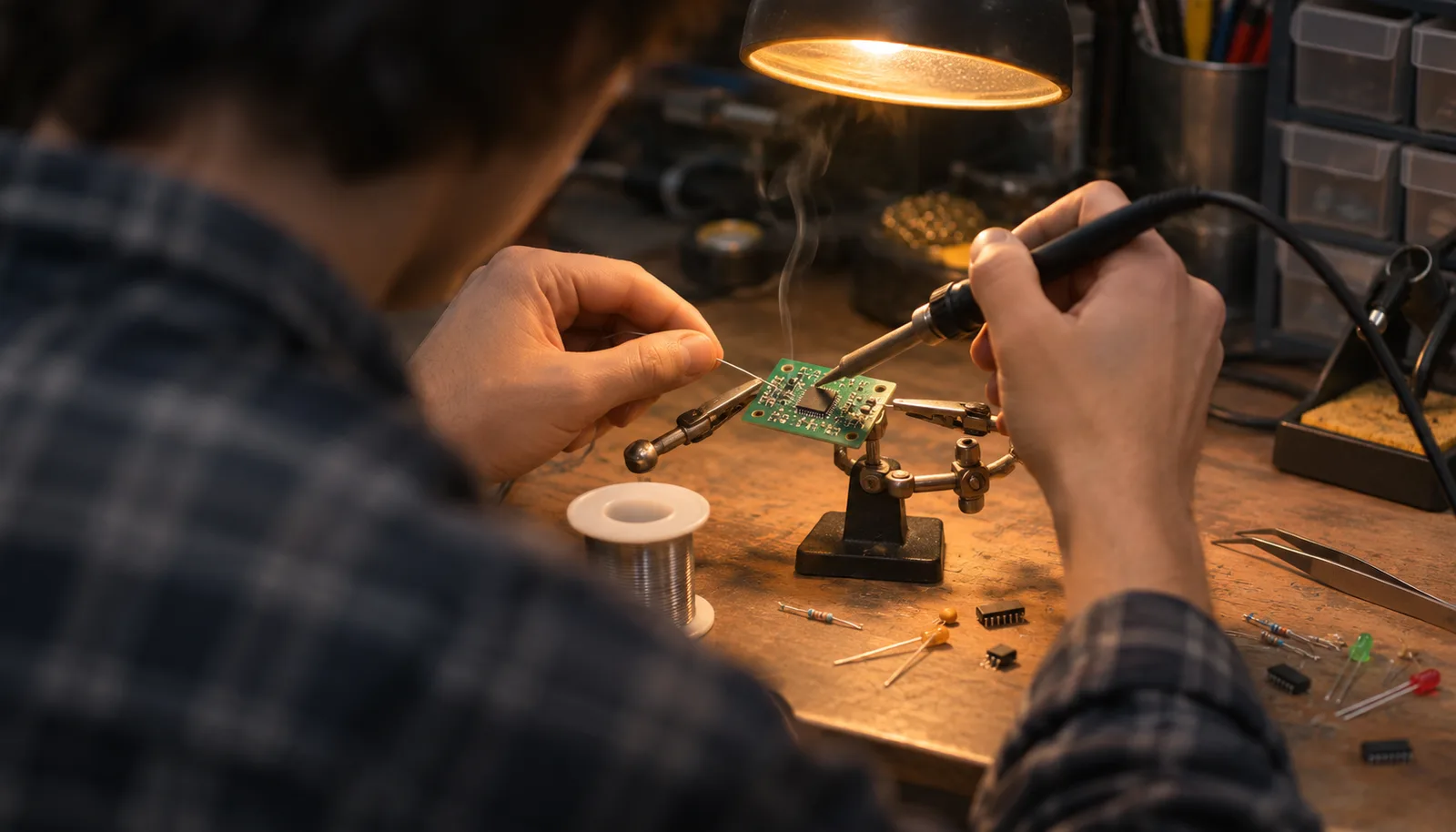
When choosing between these materials, engineers evaluate several key factors. The right choice depends on the specific demands of the application.
The general rule is straightforward: if the signal path is critical and the frequency is high, the investment in a Rogers substrate pays for itself in performance and yield. For cost-sensitive, low-frequency designs, FR4 provides excellent value.
Here are the most critical points of comparison:
- Dielectric Loss: FR4 has a high dissipation factor (Df ~0.02), which causes significant signal attenuation at high frequencies. Rogers laminates have a very low Df (0.002–0.003), making them ideal for RF and microwave circuits.
- Frequency Range: Standard FR4 is generally suitable for applications below 1 GHz. Rogers materials are engineered to perform reliably up to 77 GHz and beyond.
- Environmental Stability: FR4 absorbs moisture, altering its electrical properties. Rogers materials have extremely low moisture absorption, ensuring consistent performance in humid or thermally cycling environments.
- Cost and Machinability: FR4 is the most economical choice for high-volume, low-frequency production and is easier to drill and route. Rogers materials cost more but reduce redesign risk in high-performance designs and require specialized tooling.
Design resources like Altium's documentation emphasize that selecting a substrate with a low and stable dielectric constant is the most effective way to control impedance tolerance in high-speed designs.
Conclusion
Both FR4 and Rogers PCB substrates have well-defined roles in modern electronics. FR4 remains the reliable, cost-effective backbone for the vast majority of standard applications. Rogers laminates are the high-performance solution required for the advanced RF, microwave, and millimeter-wave systems driving today's technology.
The decision between FR4 and Rogers is rarely about one being universally better than the other. It is about matching the material to the application's specific frequency range, environmental exposure, and budget. A thorough review of the material datasheets and early consultation with your PCB fabricator can prevent costly redesigns. Whether you are developing a prototype for a new IoT sensor or a production run for a satellite communication system, the substrate is the foundation of your board's performance. Making an informed choice at this stage ensures your product meets its performance targets on time and within budget.